Wednesday, 30 October 2013

Dressing The Set

Although I enjoyed painting the set, dressing the set is really where I am in my element. I have shown, previously how I am constantly on the look out and sourcing props for our set and found many items in the studio store room which I feel will add to the atmosphere we are creating in our piece. I put these items in a box to keep them safe. 


This includes, glasses, a pipe, a clock, a cushion, some fur and other objects such as a picture of a man with an animal head which obviously, ties in perfectly with our idea. 

During the set painting session, we also discussed and agreed that instead of having a relatively small picture frame for the person to clamber through, we should simply keep the existing wooden frame and paint it to give a picture frame effect. 

We approached another group whom were using a particularly decorative wallpaper and asked if we could use a strip within our set. Our plan was to paint the flowers and patterns with gold paper, cut them out and apply them to the wooden frame. This would create the ornate style we were hoping a picture frame would. 

As we were nearing the end of the session, Emma and I decided to take the paper, paint and brushes home and work together to carefully paint each swirl gold. 


We can now cut each golden piece out and create the frame in next weeks set dressing session.

Making The Set Our Own

In order to fulfil the brief, we planned to wallpaper the three boards and then apply the paint on top of this. We felt it was best to first, strip the old wallpaper from the boards which we did using warm water and scrapers. We then used sand paper to smooth the edges of the remaining wallpaper in order to essentially, get a blank canvas for us to work with. 


Once this was done, we could measure the wallpaper and cut it into the appropriate strips and pieces. This proved a problem solving task as we wanted to keep the open window in the board, with the frame which we will later dress to look like an antique picture frame. We used a tape measure to first, measure the boards and then rolled the wallpaper out and marked with a pencil where to cut each strip. 


Following the instructions given, we then mixed wallpaper paste and applied it to our strips. Working together, we positioned the wallpaper and used a dry brush to smooth out any air bubbles. 


In order to use the time given wisely, we decided to split the roles; Emma therefore began painting the boards whilst myself and Daryl finished applying the wallpaper. 


With the wallpaper applied, we could work together to coat each board. This took some time as we really had to work the paint into the textured woodchip wallpaper using both rollers and smaller paint brushes. 


By the end of the day, our three boards were stripped, wallpapered and painted. Now we have the basis for our set, we can begin dressing it. 


Thursday, 24 October 2013

Researching Xenomelia

I wanted to research Xenomelia (also known as Body Integrity Identity Disorder) further in order to ensure I understand the condition enough to base a film sequence on it and also so I can convey the extreme nature of this condition both during my presentation and within my project proposal. 

I was aware that "Body Integrity Identity Disorder (BIID) is a condition in which individuals experience an intense desire for amputation of a healthy limb." However I felt it was important for me to grasp the effect BIID has on an individual and the life they lead. 

Anna Seda (2011) states "the discomfort for the limb is so strong that it interferes with everyday life functioning and several individuals have asked a surgeon for an amputation of the "extraneous" extremity or even performed it by themselves." This strong desire and act of amputation is what I hope to illustrate within my personal project. 


Anna Seda, 2011, Body Integrity Identity Disorder: From A Psychological To A Neurological Syndrome [online], Psychology Department, University of Pavia, Article from Springer Link, Last accessed 24th October 2013 at: http://link.springer.com.lcproxy.shu.ac.uk/article/10.1007%2Fs11065-011-9186/fulltext.html

Shopping

Today, Daryl, Emma and I went shopping for paint and wallpaper for our set. We had a budget of around £15 and managed to find a suitable colour paint for around £13. This obviously only left us with £2 for wallpaper. We struggled to 1) find a wallpaper we thought would add to the ambience we wish to create within our piece and 2) find any wallpaper around £2. I then stumbled across a 10m roll of white, textured wall paper for around £3. Seeing this wallpaper inspired me to suggest we cover each board with it and paint over the wallpaper which would both, fulfil the brief and create the unkempt, old fashioned feel we were wanting.


Wednesday, 23 October 2013

Tools and Studio Induction

During the tools induction, we were shown how to use power tools such as a jigsaw and other hand tools such as a chisel and mallet. I found this induction incredibly useful and felt confident enough to use the jigsaw and produce a half lap using two methods; with a saw and with a chisel and mallet. The pieces I made can be seen below. 

Cut using a jigsaw

Half lap I made

I understand that a half lap can be strengthened using another piece of wood, measure at a 45 degree angle and slotted into place before being secured with screws (which can be taken out when needing to transport sets) and used to support a board for a set. 

I believe, I showed this understanding when putting our boards together during the studio induction. If two boards are together, an A-frame must be placed at each end, which we did. However we felt that even with a clamp, the two boards were not stable enough to support the actor climbing through a hole on one of the boards, safely. We therefore found a spare A-frame and I marked where we should drill the holes for the bolt next week. 

The beginnings of our set for the workshop project


Fitting an extra A frame to support boards

Thursday, 17 October 2013

The New Uncanny

"In his famous essay of 1919...Freud listed eight officially uncanny tropes, that is to say eight irrational causes of fear deployed in literature:

( i ) inanimate objects mistaken as animate (dolls, waxworks, automata, several limbs etc.)

( ii ) animate beings behaving as if inanimate or mechanical (trances, epileptic fits etc.) 

( iii ) being blinded

( iv ) the double (twins, doppelganger etc.) 

( v ) coincidences or repetitions

( vi ) being buried alive

( vii ) some all controlling evil genius

( viii ) confusions between reality and imagination (waking dreams etc.)"

Eyre and Page tested Freud's theory of the uncanny by asking people to respond to the essay with new, short stories. They found an "overwhelming emphasis here on two phenomena in particular: the double and the doll." An example of this is Seeing Double by Sara Maitland, a story of a young boy whom discovers his Father and Nanny have sheltered him from the fact he has a second face on the back of his head. Once he finds out, the second face becomes another personality and controlling factor in his life. This short story is uncanny as the imagery it evokes feels so real and plausible; the reader can imagine each detail and become engrossed in the twisted story, somewhere between reality and the surreal. 


Eyre, Sarah and Page, Ra (eds.) (2008) The New Uncanny: Tales of Unease, Great Britain, Comma Press


Freud, Sigmund (1919) The "Uncanny"

Freud (1919) states that the 'uncanny' "...undoubtedly belongs to all that is terrible-to all that arouses dread and creeping horror; it is equally certain, too, that the word is not always used in a clearly definable sense, so that it tends to coincide with whatever excites dread." I vehemently agree with Sigmund Freud as from my own personal experiences and witnessing others' reactions when presented with something uncanny, it has been clear that the emotions surrounding the 'uncanny' are not pleasant and the 'thing' that has caused those emotions is often something terrible, for example, this somewhat mummified rat was found when doing some building work on our house and it instantly aroused "dread and creeping horror" and I recognised the presence of the uncanny straight away as I found I could not stop looking at it, despite the repulsion I felt. 


Prop Shopping

Today, I went shopping for objects to dress our set, using the shopping list created in this week's session.

I am extremely pleased with this purchase, from The Vault on Abbeydale Road and feel it will look just perfect in our aristocratic, vintage set. 


Wednesday, 16 October 2013

Safety

I have read the studio rules and regulations as directed to do so in today's session and noted that there is a checklist to run through when leaving the studio to ensure all is in order. 

I have also looked at how the boards are to be set up and weighted. 

Workshop Project Storyboard


Workshop Project Shot List


  • Wide angle shot of room
  • Pan of mantlepiece, stop at picture frame, long shot of picture frame
  • Mid close up, side view of picture as man climbs through
  • Tracking shot of man as he collects pipe etc. then pan to picture frame

Workshop Project Shopping List


  • material for drapes
  • burgundy paint/wallpaper
  • toy horse/cut out of horse
  • picture frame
  • chair
  • table
  • fireplace
  • mantlepiece
  • clock
  • pipe
  • horse mask
  • suit
  • newspaper
  • decanter
  • glass
  • halloween decoration cobwebs
Please note, some of these objects we are already in possession of, such as the suit, clock and pipe.

Personal Project Moodboards


Below are the two moodboards I have created for my personal project and using Photoshop, during this weeks session. The first moodboard shows the more practical side to the project, that is, the sort of props I would use and the second moodboard conveys the desired tone and mood of the piece. 

Please click on the images to view them enlarged. 


Saturday, 12 October 2013

Personal Project Idea

Below is a spider diagram of my initial ideas for the personal project task. Please click on the image to view it enlarged. 


Personal Project Research

Telling Mark (2004, Guy Ducker) was useful for me in my research for the personal project as it shows how a simple set can be designed and special effects such as the scar of Mark's face can be used to help tell the story, visually. 


(http://www.bbc.co.uk/filmnetwork/films/p004ph4q)


Time Goes Nowhere (2009, Jo Lane) encompasses two elements which I find inspirational; the subject matter itself is very touching and emotionally evocative, something I would hope to emulate in my personal project idea and the toys coming to life and use of animation shows how effects can help transport the audience into the story-world one is creating. 


(http://www.bbc.co.uk/filmnetwork/films/p00fk9sg)

Wednesday, 9 October 2013

Workshop Project Proposal

Below is our group written proposal for our film, based on the 'uncanny'.


Tag line: When neighbouring dimensions collide, a never ending cycle begins.

Log line: A masked, aristocratic man enters a dimension but is it his own?


It is a silent winter night, wind blows the drapes as we move through them, in to a darkened room. The walls are a stylish burgundy and cast upon one is the shadow of a horse; hanging on the wall is a decorative vintage picture frame encasing a photograph of a landscape. A chair and table are positioned in front of a fireplace. The fireplace is framed by a mantelpiece and on the mantelpiece there is an antique style clock, a pipe and a burning candle, the wax slowly slithers towards the mantelpiece, licking the sides of the candle.

The hands on the clock skip counter-clockwise, as the hands greet one another, harrowing and disjointed music begins. We return to gaze at the picture on the wall as a figure appears in the previously barren and isolated landscape. The figure approaches the foreground of the photograph and it becomes apparent that the figure is in fact a man, wearing a horse’s mask. The man reaches towards the picture frame and clumsily clambers through and in to the room.

As the man slowly stands upright, he adjusts his garments and turns towards the mantelpiece and cradling the pipe he picks up, heads towards the table and chair. On the table are a newspaper and a decanter and glass, inviting the man in. He proceeds to take a seat, pours himself a drink from the decanter and settles down to read the newspaper.


Our attention is drawn back to the picture, on the wall and we are faced with the side profile of the man within the landscape again, who turns slowly and gazes directly through the photo, at us. 

Moodboards


The moodboard above, created on Photoshop shows the objects and content we would like to use within our set for the workshop project, whilst the moodboard below shows the tone and mood we hope to achieve. Please click on the images to enlarge.

Workshop Project Ideas


We discussed as a group our initial ideas for the workshop project and how each could work under the topic of 'uncanny' and be developed within a sequence. This spider-diagram of our combined ideas then helped us to create a pretty solid idea which will be explained further in our proposal. 

Monday, 7 October 2013

Gunther von Hagens

Gunther von Hagens is well known for "his pioneering invention that halts decomposition of the body after death and preserves it for didactic eternity." 

Gunther von Hagens has plasticised animals and humans, including his closest friends after their deaths; his work takes the 'uncanny' to the extreme with the use of human bodies so grotesquely stripped of their human essence yet holding some sort of characteristic and presence in the living world. 


(http://www.bodyworlds.com/en/gunther_von_hagens/life_in_science.html)

Friday, 4 October 2013

John Hunter

John Hunter was a scientist and surgeon during the 1700s, his work at the time was controversial as he assisted his brother William in dissection before moving on to experimentation on animals and deceased humans. 

The Hunter's were working during a time in which body-snatching and grave-robbing were a growing problem as medics and scientists would pay large sums of money for a fresh corpse. However without their thirst for knowledge regarding anatomy and experiments, it can be argued that many would have died from illnesses, conditions and injuries which could be treated by surgery and medical care and we perhaps would not have the advanced medical knowledge we do now. 

Although John Hunter is not a film-maker or artist, I feel without knowing it, he was taking something familiar (the human body) and doing something unfamiliar with it, that is, dissecting it and performing surgery. Thus resulting in revulsion from some members of society which in turn was caused by the feeling of the uncanny. 

John Hunter's work can be seen in the Hunterian Museum at The Royal College of Surgeons and it is the specimens on display here which cause a feeling of unease, for example, in the images below, one can recognise the individual body parts of a human being and the animals on display but the context in which they are being viewed alters a person's reaction; it is not the norm to see a foot detached and a monkey in a jar. 


I feel as a group, we could recreate some of the specimens of Hunter's and use them to decorate our set as this would be effective in creating the uncanny and that feeling of disturbance for the viewer. 


(Science Britannica: Frankenstein's Monsters  http://www.bbc.co.uk/iplayer/episode/b03bjpcy/Science_Britannica_Frankensteins_Monsters/)

Thursday, 3 October 2013

Uncanny Valley

The 'uncanny valley' refers to the hypothesis that human beings react in a certain way when presented with something which has human qualities but is not actually human, such as, a robot/humanoid. 


In 'Exploring the uncanny valley of how brains react to humanoids' (http://www.wired.co.uk/news/archive/2011-07/19/uncanny-valley-tested) Mark Brown states that when a person is presented with a humanoid robot, "the brain" cannot "compute the incongruity between the android's human-like appearance and its robotic motion" which causes a "drop in likeability as onscreen characters and humanoid robots step too far towards being human-like"; this change in response is the 'valley'. 


This suggests that recognising the uncanny is universal, shared by all and our reaction, uncontrollable. Once one understands the reasoning behind the 'uncanny' and the feeling of unease, one can learn how to provoke said feelings; something we will do within our piece.  

Gitta Gschwendtner

Gitta Gschwendtner takes certain objects and uses them to create another object which resembles something in an uncanny manner, for example, Gschwendtner used wine glasses to create a chandelier; it is a 'glass chandelier' but not as we know it. 


This shows how we, as a group could show the 'uncanny' through unusual objects or pieces of furniture within our set. This is a different approach to showing the 'uncanny' through making an object come to life, this approach gives the object a new depth and dimension. 

(http://www.gittagschwendtner.com/about_frameset.html)

Jan Svankmajer

Jan Svankmajer is an example of a film-maker whom uses objects to express the uncanny; he does this through bringing the objects to life via movement resembling human characteristics. This results in a sinister and eerie atmosphere within Svankmajer's short films.  

Svankmajer's Jabberwocky (1971) shows how stop motion animation can be used to make it appear as though objects have come to life. 


Jabberwocky has frightening qualities as familiar objects have become strange, for example, Svankmajer uses dolls which many can relate to as a comforting and recognisable toy from childhood, however Svankmajer has taken the innocence from the objects as he shows them partaking in 'cannibalism', accompanied by a somewhat eerie soundtrack. The awareness of the uncanny here leads to a feeling of repugnance from the viewer. 

The familiar genre also adds to the 'uncanny' as with animation, one has certain expectations regarding style and content, that is, most would imagine Disney and children's animated films. However Svankmajer has taken the genre of animation to a whole new level and twisted and warped it until it is somewhat unrecognisable. This again is challenging the viewer's knowledge of animation and what an animated film involves. 

Jan Svanmajer is bringing something to life that should not have life and this is what causes the confusion between animate and inanimate. 


Sandy Skoglund


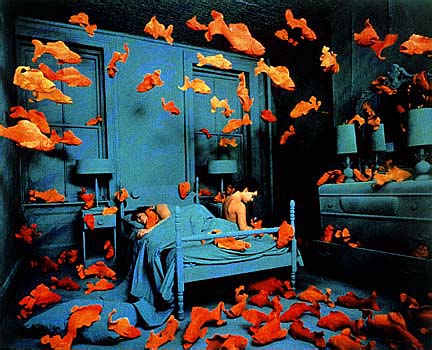
I have found researching Sandy Skoglund extremely useful as she works in a similar way we are required to during our group project, that is, she designs and builds sets under the theme of 'uncanny' and 'surrealism' before photographing them. 


"In her work, Skoglund explores the aesthetics of artificiality and the effects of interrupting common reality" whilst "the juxtapositions she creates...are surprising, strange and new." These juxtapositions give way to the uncanny ambience her work encompasses.   


This particular piece offers an example of the aforementioned juxtapositions, the form of the baby is nothing new to the viewer yet the scale is; the size of the 'sculptures' conflicts the thoughts and emotions which are usually produced at the sight of a baby, that is, an instinctive need to look after and be close to the child. Skoglund's portrayal of the babies, makes the viewer reconsider such feelings as the their unusually large size and confident stance suggests they are 'independent'. Uncanny.


Surreal: Having the qualities of surrealism; bizarre: "a surreal mix of fact and fantasy" (Google definitions)

When one considers the definition of 'surreal' and 'surrealism', it is obvious that Sandy Skoglund works within this realm, when creating her sets, for example, the image below shows how Skoglund has taken a 'typical' scene of a couple in a bedroom at night and added an element of surrealism with the introduction of the 'flying' fish. This scene pulls the viewer into a dream scene and one can almost sense the fluid motion of the fishes movement around the room. This is also encouraged by the colours chosen by Skoglund, the less important objects such as the lamps are a dull blue/grey colour whilst the people and fish are bright skin coloured and orange, thus drawing the viewer's attention to them. 

I really admire what Sandy Skoglund has done with the colours and dressing of her sets and would hope to emulate this in my own work. 


(http://www.learner.org/courses/globalart/work/242/index.html)


Ron Mueck

"Hyperrealist sculptor Ron Mueck works in the realm of the ultra-real" which means that he takes great care and consideration when creating his sculptures, perfecting each one until they holds a true resemblance to the human form. "Each sculpted person is as bizarre as it is amazing" as Mueck ensures each portrays a certain character and characteristics, through facial expression, 'stance' and the detail and texture of the skin and hair. 

At first glance, the sculptures could be mistaken for real human beings, it is only when one takes a step back to consider the scale of the sculpture that the uncanny is realised and that sense of unease is felt; the attention to detail and true human likeness evokes an automatic connection to the 'character' yet the sometimes insane size of the sculpture, causes the viewer to challenge the initial feeling of association and ponder how something so obviously not human or living, can look so life-like.  

Mueck's work also encaptures the 'uncanny' in another sense; a majority of his sculptures are positioned in such a way as to suggest they are somewhat vulnerable, for example, the sculpture of two individuals lying in the foetal position as though to protect themselves and each other, the elder man sat in the corner with his knees brought high and his hand brought to his face (a typical 'thinking' position); as a viewer, one views this particular sculpture and begins to wonder what the character could be thinking about. This theme of vulnerability results in cognitive dissonance as the empathy the viewer feels towards the sculptures and the overall aura each produces, contrasts dramatically with the overpowering presence of the sculpture. It is almost as though the sculptures themselves are resentful of the attention Ron Mueck has brought them. 


(http://www.thisiscolossal.com/2013/05/new-hyperrealistic-sculptures-by-ron-mueck/

Wednesday, 2 October 2013

Uncanny

The 'uncanny' can be defined by the Freudian concept where something is familiar yet at the same time, seems foreign in some way; this results in an uncomfortable feeling of strangeness, for example, a mannequin or wax work may look human in appearance which causes a slight feeling of unease to the person viewing it as the individual is aware the mannequin is and cannot actually be human.

This can be supported by Ernst Jentsch's 'On the Psychology of the Uncanny' (1908) in which Jentsch considers 'uncanny' in the terms previously mentioned,


 "...doubts whether an apparently animate being is really alive; or conversely whether a lifeless object might be, in fact, animate."